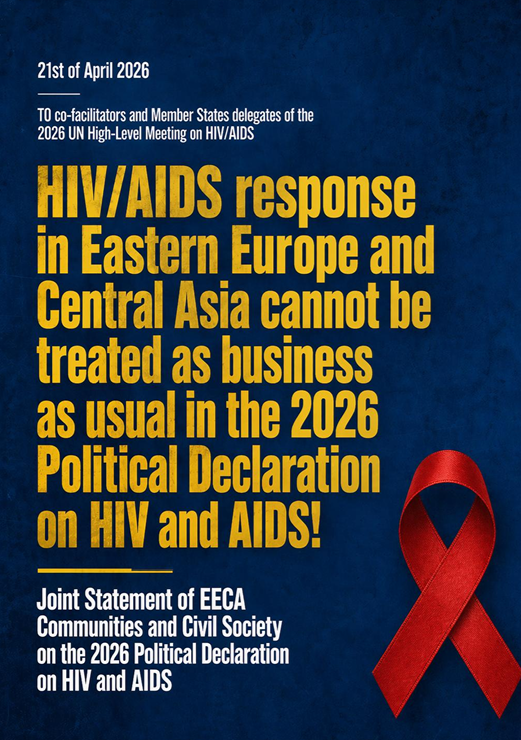
EECA Regional Platform has contributed to the efforts and coordination of gathering input and signing the statement “HIV/AIDS response in Eastern Europe and Central Asia cannot be treated as business as usual in the 2026 Political Declaration on HIV and AIDS!” by 40 community and civil society organisations from Eastern Europe and Central Asia. The statement was sent to the Office of the President of the 80th General Assembly, the Permanent Missions of Botswana and Georgia to the United Nations, the co-facilitators and Member States delegates of the 2026 UN High-Level Meeting on HIV/AIDS, with the Multistakeholder Task Force co-chairs and UNAIDS Secretariat in copy.
The UN High-Level Meeting on HIV/AIDS is a key global political process through which Member States review progress, define priorities and negotiate a new Political Declaration on HIV and AIDS. The 2026 meeting is expected to shape the next phase of the global AIDS response and will be informed by the Global AIDS Strategy 2026–2031, which includes new global targets for 2030 and resource needs estimates. (UNAIDS)
The statement was developed because Eastern Europe and Central Asia cannot be addressed through generic global language. EECA remains the only region where both new HIV infections and AIDS-related deaths have increased since 2010. Communities and civil society organisations stress that this is not a technical failure, but the result of political choices: criminalisation, punitive laws, shrinking civic space, chronic underfunding of prevention and community-led responses, donor transition without safeguards, war, displacement, migration, and continued exclusion of the people most affected by HIV.
In the statement, organisations call on Member States to ensure that the 2026 Political Declaration responds directly to the realities of the EECA region. The statement urges governments to protect and finance evidence-based HIV prevention, including harm reduction; remove punitive legal and policy barriers; protect civil society space; sustain community-led responses; ensure access to treatment, medicines, diagnostics and new technologies; integrate HIV, TB and hepatitis services; and guarantee continuity of care for migrants, refugees and people affected by war and displacement.
The statement also calls for the Political Declaration to explicitly name all key populations, including people who use drugs, sex workers, transgender people, gay, bisexual and other men who have sex with men, and people in prisons and other closed settings. It further stresses that women living with HIV, women who use drugs, women engaged in sex work, migrant women, women affected by displacement, adolescents and young people must be visible in the commitments adopted by Member States.
A central message of the joint statement is that meaningful community engagement must go beyond consultation. Communities must be able to influence the Political Declaration itself and its implementation. The statement also calls for stronger coordinated UN leadership on HIV, with the UNAIDS Secretariat at the centre of coordination, accountability and engagement with communities.
The joint statement was prepared and signed by 40 community and civil society organisations, including regional networks and national organisations working on HIV, harm reduction, human rights, community-led monitoring, gender equality, health in prisons, migration, sex workers’ rights, LGBTQI+ rights and the rights of people who use drugs.
As stated in the joint appeal:
“The 2026 Political Declaration must protect communities, sustain services, remove punitive barriers, preserve civic space and turn commitments into funded, measurable and accountable action.”
EHRA and partners encourage civil society organisations, communities and allies to disseminate the statement through their networks and communication channels, and to use it in advocacy with governments, UN missions, international partners and donors ahead of the 2026 UN High-Level Meeting on HIV/AIDS.